
Being a victim of Financial Fraud in Saudi Arabia or a scam raises urgent questions for many: Is what happened actually a crime? Should I start with the bank or the police? And is it possible to recover the money?
This guide explains the crime of fraud and scams in Saudi Arabia in a practical and concise manner, focusing on the legal elements, the difference between fraud and breach of trust, and the first steps to take when a scam occurs. Saudi law criminalizes the illegal seizure of others’ property through fraudulent means, providing official channels for reporting based on the nature of the incident.
Have you fallen victim to a scam and fear losing your money or rights because you don’t know where to start, how to preserve evidence, or what penalties the perpetrator might face? Don’t let confusion give the scammer more time; you can now request initial criminal guidance to help you understand the correct path, how to file a report, and the best steps to secure your legal position.Request Initial Guidance for a Fraud CaseIf you prefer to know the details first, please continue reading.
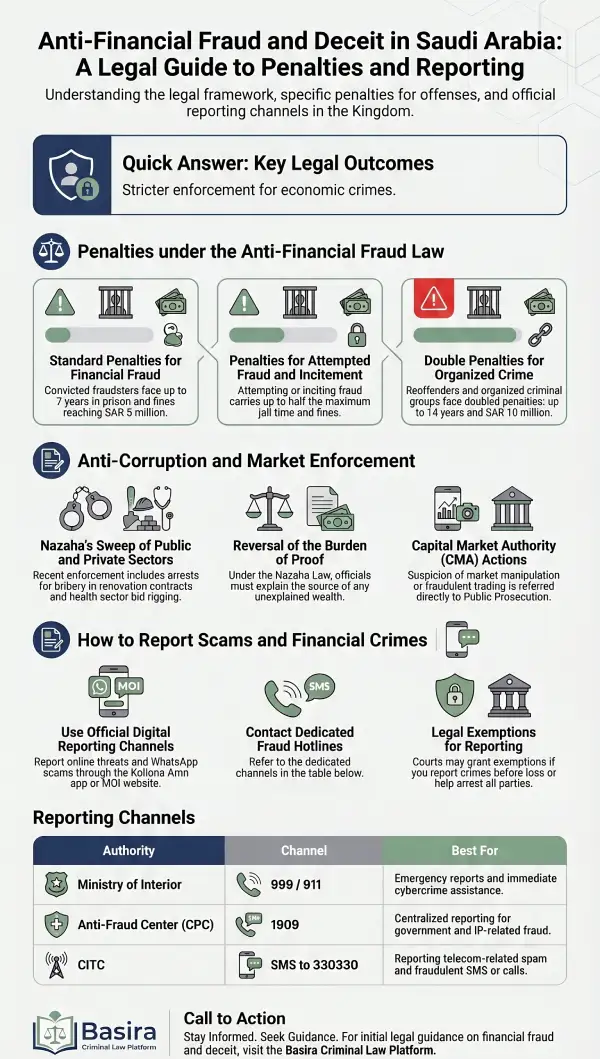
Table Of Content
What is Meant by Fraud and Scams in Saudi Arabia?
The description of fraud and scams is fundamentally based on the illegal seizure of others’ property using deception, lying, delusion, or any fraudulent means that induces the victim to hand over money. Therefore, the issue is not just about the transfer of money, but the reason for its transfer and the method used to obtain it. The Financial Fraud and Breach of Trust Law clearly defines this legal framework.
Difference Between Financial Fraud, Breach of Trust, and Electronic Fraud
The difference can be simplified as follows:
- Financial Fraud: Money is obtained through prior deception or intentional delusion.
- Breach of Trust: Money was originally delivered legitimately, then illegally seized or disposed of later.
- Electronic Fraud: Fraud occurs via the internet, apps, links, or technical means; in this case, the Anti-Cybercrime Law may overlap with the legal characterization of the case.
When Does a Financial Dispute Turn into a Crime?
Not every dispute over an amount of money, contract, or partnership is considered a crime of fraud. Usually, the incident moves toward a criminal description when one or more of the following are present:
- The existence of a deceptive method prior to the delivery of money.
- Providing a false identity, misleading information, or incorrect documents.
- Proof that this deception was the direct cause that prompted the victim to transfer or deliver the money.
- Evidence of the intent to seize the money from the beginning, not just a subsequent failure to perform.
Common Types of Fraud and Scams in Saudi Arabia
Some of the most common forms in this area include:
- Text messages or links claiming to be from a banking or official entity.
- Requests to update card or account information.
- Impersonating a company, investment platform, or online store.
- Promises of high profits or undocumented investment opportunities.
- Urgent requests to transfer money to a personal account.
- Prize, employment, or fake offer messages.
It is important to note that many of these incidents start with a very small detail, such as a message, call, or advertisement, and then evolve into a financial transfer or disclosure of sensitive data. Therefore, saving messages, notifications, links, and data from the first moment is crucial in fraud cases.
What are the Elements of the Crime of Fraud and Scams in Saudi Arabia?
The elements of the crime of fraud in the Saudi system can be summarized in three main points:
- Legal Element: The existence of a legal text that criminalizes the act. The primary reference here is the Law of Combating Financial Fraud and Breach of Trust, and the Anti-Cybercrime Law may overlap if the act was committed via technical means.
- Material Element:
Includes:- The act of deception, lying, or delusion.
- The transfer of money, benefit, signature, or document.
- A causal relationship between the deception and the delivery.
- Mental Element: Criminal intent, meaning the perpetrator’s knowledge that they have no right to the money and their will to seize it unlawfully.
What is the Penalty for Fraud and Scams in Saudi Arabia?
- The penalty for financial fraud can reach: Up to seven years in prison, a fine of up to five million riyals, or both.
- The penalty for breach of trust can reach: Up to five years in prison, a fine of up to three million riyals, or both.
- If the fraud was committed via technical means, the Anti-Cybercrime Law may apply in some cases, with penalties reaching: Up to three years in prison, a fine of up to two million riyals, or both.
How to Report Fraud and Scams in Saudi Arabia
First steps to file a fraud report in Saudi Arabia:
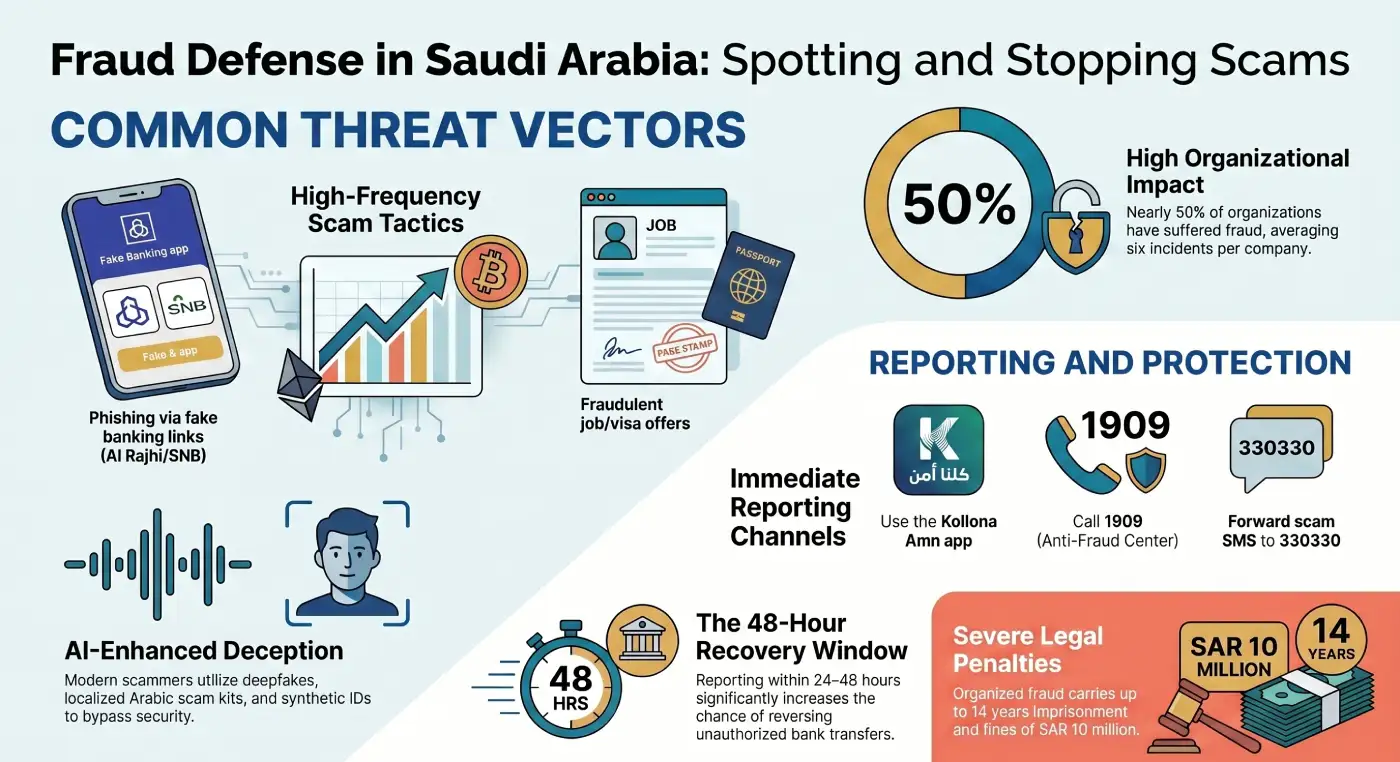
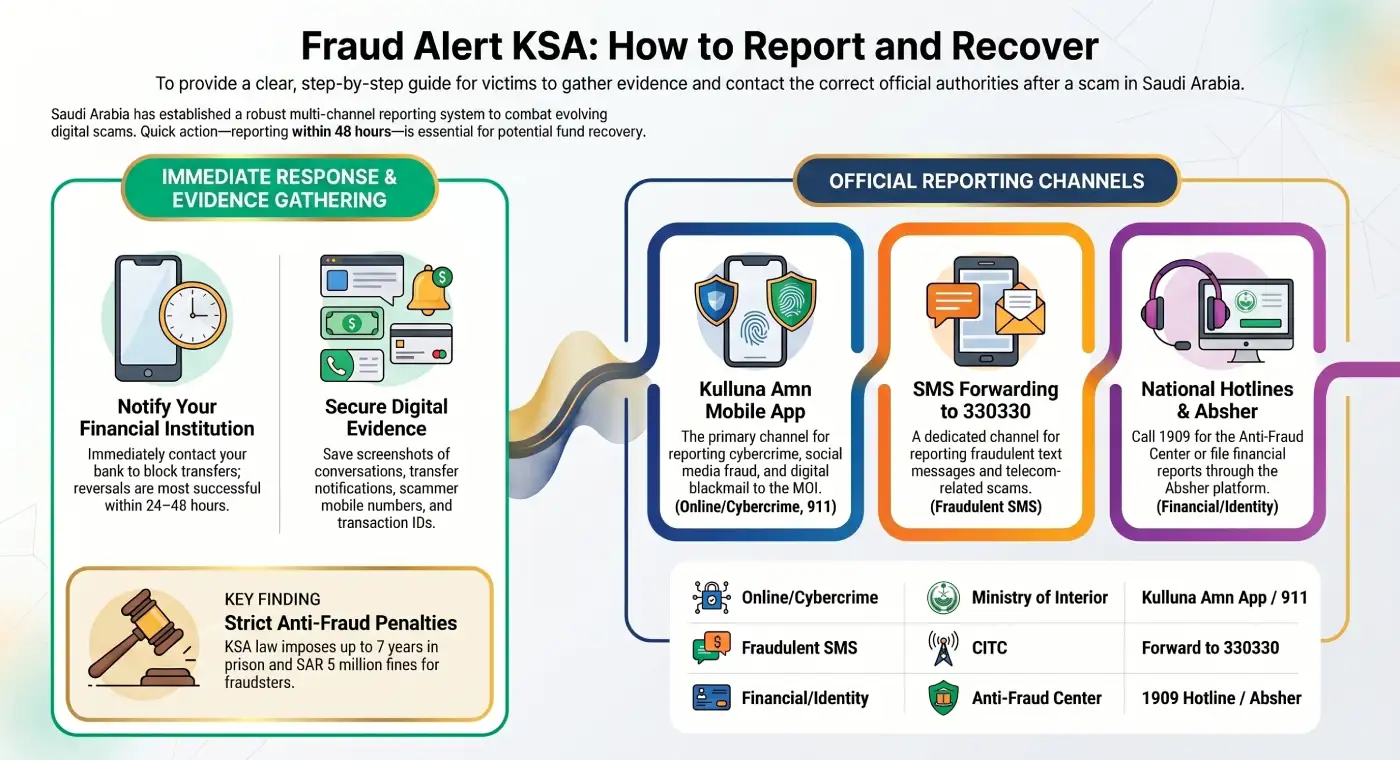
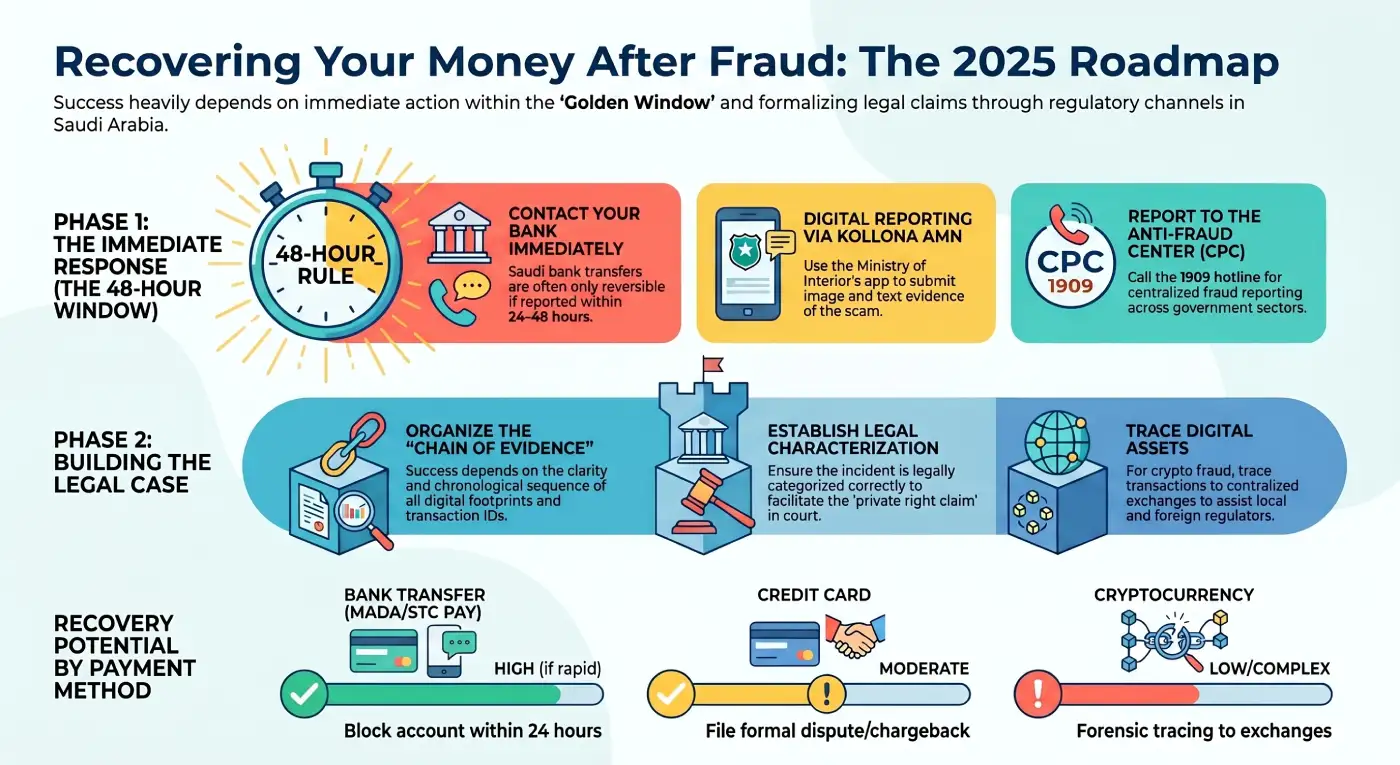
- Contact the bank or financial institution immediately if a transfer or financial transaction occurred.
- Prepare:
- Transfer notifications.
- Account or mobile numbers.
- Conversations and messages.
- Screenshots.
- Choose the appropriate official channel, such as:
- Financial fraud reports via Absher.
- Cybercrime reports.
- “Kulluna Amn” app depending on the nature of the incident.
- If the matter is only a fraudulent SMS, it can be forwarded to 330330 as a dedicated channel for fraudulent text messages, not for all types of reports.
How to Prove a Fraud Crime and Protect Your Position?
In fraud cases in Saudi Arabia, the strength of the file begins with the strength of documentation. The most useful items are usually:
- Bank statements.
- Transfer notifications.
- Contracts or agreements.
- WhatsApp, email, or text messages.
- Images of advertisements, pages, or links.
- Account numbers or mobile numbers used.
- Any data proving that deception preceded the delivery of money.
It is also recommended to:
- Avoid deleting any messages.
- Avoid entering into long arguments with the other party.
- Do not send additional documents after suspicion.
- Write down the chronological sequence of events from start to finish.
Can Money Be Recovered After Fraud?
Recovering money after a scam is possible in some cases, but it is not a guaranteed outcome in every incident. What usually increases the chances of a correct move is:
- Speed of contact with the bank.
- Speed of filing the report.
- Clarity and sequence of evidence.
- Correct legal characterization of the incident.
- Organizing the private right claim in a legal manner.
Therefore, it is a mistake to reduce the issue to a single question like: Does money come back after fraud? Because the true answer depends on:
- The type of fraud.
- The timing of the report.
- The movement of the funds.
- The presence of multiple parties or sequential transfers.
- The legal follow-up path.
When Do You Need a Criminal Lawyer or a Fraud Lawyer?
In some cases, organized reading and starting the report are enough, but there are cases where contacting a criminal lawyer or a fraud lawyer is more important, such as:
- If there is a summons or an ongoing investigation.
- If the transfers are large or multiple.
- If the incident is related to:
- Fake investment.
- Electronic platform.
- Partnership or agency.
- Breach of trust.
- If you want to arrange the private right and recover money legally.
- If you do not know whether to start with a report, a lawsuit, or a civil claim.
How Basira Criminal Law Platform Helps You in Fraud Cases
If you are facing a fraud case, the role of the “Basira Jinaiya” platform is not limited to theoretical explanation; it starts by organizing the picture for you calmly. Basira Jinaiya helps you simplify procedures, explain regulations, and connect the beneficiary with a suitable fraud case lawyer.
Practically, the platform can help you with the following:
- Understanding whether the incident is fraud or just a financial dispute.
- Arranging evidence before it weakens or gets lost.
- Clarifying the difference between a police report, a lawsuit, and a private right.
- Guiding you to the most appropriate page on the site according to your case.
- Helping you determine when you need a criminal lawyer and when your need is more specialized for a fraud lawyer.
Frequently Asked Questions About Fraud Cases in Saudi Arabia
Is every financial dispute considered a crime of financial fraud in Saudi Arabia?
No, not every financial dispute is classified as a crime of financial fraud in Saudi Arabia. For a case to be considered fraud, there must be evidence of deception, delusion, or a fraudulent method that induced the victim to hand over money. A mere failure to fulfill a contract or a disagreement over execution is generally not enough to constitute a criminal act.
How do I report someone who scammed me in Saudi Arabia?
To report a scammer in Saudi Arabia, your first step should usually be contacting your bank if a financial transfer was involved. Next, gather all essential evidence and file an official report through the appropriate channel, such as the "Absher" platform, the "Kulluna Amn" app, or the Electronic Crime reporting portal, depending on the nature of the incident.
Is it possible to recover money after a scam?
Recovery is possible in some cases, but recovering money after fraud depends heavily on how quickly you act, the clarity of the evidence, the transfer path, and the legal characterization of the case. There is no single guaranteed outcome for all cases.
What is the difference between financial fraud and breach of trust?
The primary difference lies in the timing of the deception. Financial fraud is usually based on a prior deception used to gain access to the money. In contrast, breach of trust occurs when money was originally handed over legally and legitimately (e.g., for safekeeping or business), but was subsequently seized or disposed of unlawfully. This leads to different legal descriptions and penalties.
What is the penalty for financial fraud in Saudi Arabia?
Under the Saudi legal system, the penalty for financial fraud can reach up to seven years in prison and a fine of five million Saudi Riyals. There is a separate penalty for breach of trust, and Cybercrime Law provisions may overlap if the fraud was committed using technical or electronic means.
How do I know if I need a criminal lawyer or a specialized fraud lawyer?
If the incident is broad or involves a general investigation, summons, or a wide criminal description, starting with a criminal lawyer is appropriate. However, if the issue is specifically focused on fraudulent transfers, "ghost" investments, or obtaining money through deception, a fraud and scam lawyer is often the most suitable choice for your case.
The crime of fraud and scams in Saudi Arabia is one of the crimes that require calmness in assessment and speed in action. Most importantly, the victim must start by understanding the correct description of the incident, then preserving evidence, and finally following the appropriate official path without delay or confusion. If the picture is still unclear, the best start is from organized content and a specialized reference that clarifies whether you are facing a normal financial dispute or a crime that requires a report and follow-up with a criminal lawyer or a fraud lawyer.
Start with the Basira Criminal Law Platform, send a summary of the incident and preliminary documents, or contact us via WhatsApp for a confidential general criminal consultation.
Sources:
- Financial Fraud and Breach of Trust Law.
- Anti-Cybercrime Law.
- Law of Criminal Procedure.
- Executive Regulations of the Law of Criminal Procedure.
